Honeycomb Cushion: For Back Pain and Pressure Relief when Sitting at Your Desk, Sofa or Car.
By Jessica Kenney DC Mchiro (Doctor of Chiropractic) - November 2025 (Essex, UK)
NB: Some links may be affiliate links, which means we may earn a small commission at no extra cost to you, and often allows us to provide you a discount. We only feature products we use ourselves, and see the positive differences in your health and well-being.
HONEYCOMB CUSHIONS FOR BACK PAIN
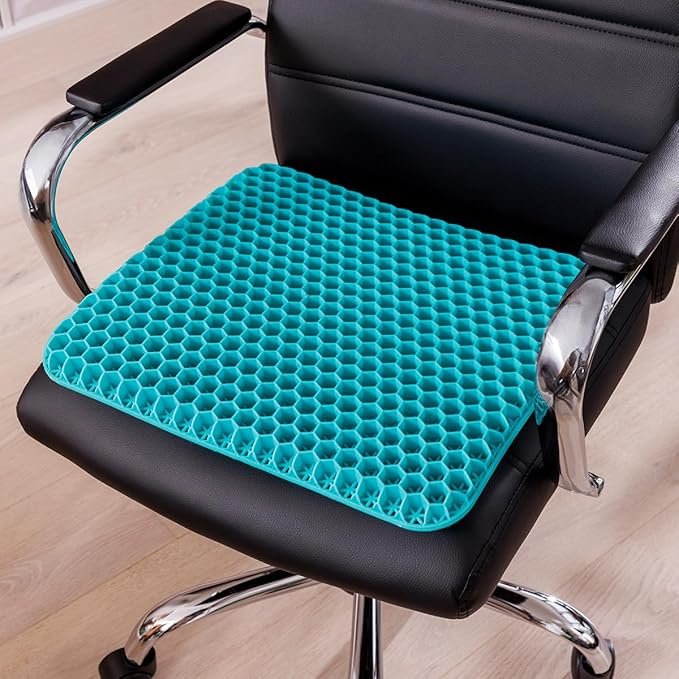
Honeycomb cushions are the new (and much more popular) orthopedic cushions that help reduce pain and stiffness when sitting, and improve the time limit before aching starts.
Whether you’re feeling pain from medical conditions like arthritis, sciatica or coccodynia, or feeling stiff from sitting too long at work or the car, honeycomb cushions are an easy, cheap and highly effective way to relieve lower back, hip and tailbone pain.
You can scroll to the bottom of this article to read about the most common pain conditions that are relieved with honeycomb cushions.
There’s no magic product that fixes everything, but how you sit and what you sit on does make a huge difference.
Shop on Amazon now.
Current price (6/01/2026): £14.99
What are Honeycomb Cushions?
Honeycomb cushions are a great, lightweight, portable cushion that you can sit or kneel on. They are a honeycomb design, made of flexible, plastic material and the one we personally recommend, JML Soft Sitter, is designed with Elastamore technology. This absorbs pressure by collapsing in on itself, ensuring you can sit all day with significantly less discomfort and back pain.
Honeycomb cushions make it more comfortable to be seated for long periods, especially if you have lower back pain from your position, general tension, arthritis, coccyx, stenosis, sciatica, or sacro-iliac issues. I have found much better results with honeycomb cushions vs the old gel-type orthopedic cushions with both relieving pain, and ease of taking around with you.
Why Does Sitting Hurt Your Back?
Whilst a lot of people do hurt when sitting, the biggest factor is the amount of time you’re there, rather than the position itself. Sitting for long periods puts constant pressure on your lower back and hips, especially when the spine isn’t well supported.
Over time, sitting builds pressure in the spine as it is a compressive force. This stiffens joints, tightens or fatigues muscles, and makes your back work harder than it should. This is especially true if you have a condition that affects the shock absorption capacity of your back such as disc issues, arthritis or spondylosis, sciatica or injuries.
How Should We Sit To Reduce Lower Back Pain?
Please click here for our how to sit neutral - not too slouched, not too straight blog. The honeycomb cushion automatically supports a neutral position, meaning it feels more comfortable, less awkward and more natural to sit up properly.
How Do Honeycomb Cushions Work to Reduce Back Pain?
Pressure Redistribution: The honeycomb only collapses where weight is applied, meaning it doesn’t dip or sink and it spreads the body weight more evenly than traditional orthopedic gel cushions
Micro-movement: Allows tiny, controlled movement to avoid excessive stress building up in one joint, but not so much that there’s instability or excessive movement. It absorbs shearing forces that your body would normally have to adapt to. Another advantage over traditional orthopedic cushions which will ‘correct’ the posture but keeps you rigid, meaning muscle fatigue and pain will build up quicker.
Better Pelvic Positioning: Naturally keeps the pelvis in a more neutral position without excessive over-sitting (anterior pelvic tilt) or slouching (posterior pelvic tilt) but it is flexible enough to allow for shifts through movement. It just doesn’t force one position, and makes it comfortable to hold neutral for longer.
Less Muscle Guarding: As pressure and shear forces are reduced the glutes, deep gluteals and piriformis don’t have to protect or work as hard. This means muscles stay happier and less tense.
It increases the ‘comfort time’ of your spine. Being seated is a loaded position for the spine, but you’ll have more endura
Airflow: More of a bonus point, but the honeycomb design means good ventilation, so skin temperature and blood flow remains unchanged.
Is There Anything you Need to Be Careful on When Using a Honeycomb Cushion?
Not at all! They are safe for everyone.
Does it Matter Which Honeycomb Cushion I use?
Nope! We use this one in clinic with great results which is why we recommend this one. If you buy different ones then check the weight limits, or whether reviews say they break. The older versions of these were the orthopedic gel cushions, which were good and did still help but across the board I am seeing better results from the honeycomb cushion than I ever did with the orthopedic gel cushions.
What Conditions do Honeycomb Cushions help with?
All of the following conditions respond well with the pods. As always, having a multitude of approaches is best, but the hedgehog pods are the single best allrounder for foot rehab.
Arthritis, Spondylosis or Spondylitis, Stenosis
Honeycomb cushions help arthritic pain because their flexible, open structure spreads body weight more evenly, which reduces pressure on sensitive joints. They also gently move with you instead of pushing back, helping limit stiffness and discomfort while allowing better airflow to keep the area comfortable.
Sciatica
Sciatica is entrapment of the sciatic nerve along any of its nerve roots, or the main part of the nerve into your buttocks. These cushions reduce the stress on the nerve or its roots, meaning less inflammation of the nerve.
Discs
Honeycomb cushions can help with disc bulges by reducing pressure on the spine when sitting and supporting the hips so the lower back stays in a more neutral position. By absorbing shock and allowing small, natural movements, they help limit strain on the discs and reduce irritation during long periods of sitting.
Hypermobility
The honeycomb cushion takes some of the load off of joints which may be unstable or do not appreciate constant strain., allowing your body to keep redistributing the load and no excessive build up in on area.
Sacro-iliac
A Soft Sitter slightly offloads the tailbone and spreads weight through the sit bones, which reduces shear and compression at the SI joints.
Coccydynia - Coccyx Pain
On a normal chair, the coccyx often takes direct pressure, especially if you slouch or sit back. The Soft Sitter is shaped so your weight is carried by the sit bones, not the tailbone — so the coccyx isn’t being crushed between your body and the chair.
Work or life related tension
Even with no underlying medical condition, our bodies don’t always get the variety they need to stay strong, adaptable and resilient. Everyone from who’s required to sit for long periods including desk workers, commuters or frequent fliers, lorry drivers, to teachers or parents that sit on the floor, to long car journeys benefit from honeycomb cushions.